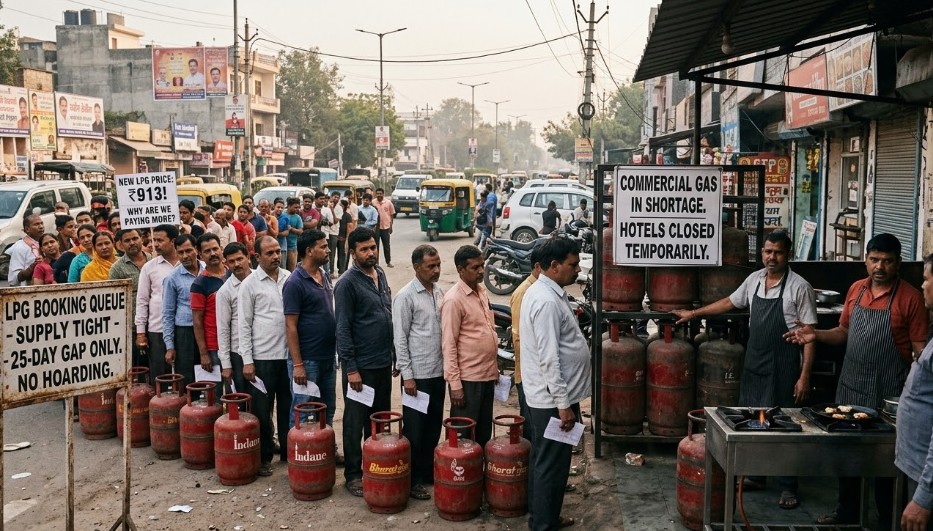
If you tried booking a gas refill recently or visited your favourite local restaurant, you may have noticed something unusual. Across many cities, from Mumbai’s busy street-food lanes to Bengaluru’s popular tiffin spots, people are talking about a new problem: LPG cylinders are getting costlier and, in some places, harder to find.
What is usually a routine kitchen item has suddenly become part of a bigger national conversation. Rising prices and supply worries are starting to affect both households and small food businesses.
Here’s a simple look at what’s happening.
What’s Happening? The Key Points
Price Increase
On March 7, 2026, the price of domestic LPG cylinders was raised by 60 rs. This means a standard 14.2 kg cylinder now costs around 913 rs in Delhi. Commercial cylinders, which restaurants and small food businesses depend on, became even more expensive with a hike of 114.50 rs.
Supply Pressure
A conflict in West Asia has affected shipping routes near the Strait of Hormuz, one of the world’s most important oil and gas transport routes. Since India imports more than 60% of the LPG it uses, any disruption in this region quickly affects supplies at home.
Restaurants Feeling the Heat
Restaurant groups in cities like Mumbai, Bengaluru, and Kolkata have warned that commercial gas supplies are becoming irregular in some areas. If the situation continues, small eateries, street vendors, and cafés may struggle to run their kitchens smoothly.
Why Are LPG Prices Going Up?
The main reason is the rising cost of energy in global markets. Ongoing tensions in West Asia involving the United States, Israel, and Iran have pushed crude oil prices above $90 per barrel. At the same time, the cost of liquefied natural gas (LNG) has also increased sharply.
India buys a large portion of its LPG from global suppliers. Oil companies here set their prices based on international rates, including the Saudi Contract Price. When global energy becomes expensive, LPG prices in India usually go up as well.
Shipping disruptions are also adding to the problem. Tankers carrying fuel are facing delays and longer routes, which increases transport costs and slows deliveries.
Is There Any Relief for Consumers?
Some relief is available for low-income households. Under the Pradhan Mantri Ujjwala Yojana, more than 10 crore families receive a subsidy of 300 rs per cylinder. Because of this support, these households pay around 613 rs instead of the full market price of 913 rs.
However, most middle-class households and small business owners do not receive this subsidy. For them, the higher cylinder prices directly affect monthly budgets.
Restaurant owners say the rising cost of commercial cylinders could also push up food prices if the situation continues.
The situation may improve if tensions in West Asia ease and shipping routes return to normal. If global oil prices fall, LPG prices could also stabilise.
Meanwhile, India is looking for additional LPG supplies from countries such as Algeria, Australia, and Canada to reduce dependence on the Middle East.
For now, households and businesses may have to deal with slightly higher gas bills. And until the global situation improves, the humble gas cylinder could remain a talking point in kitchens across the country.